 Heath

Guides Career stages
Engineer-to-Manager Compensation Transition Planning
Moving from IC to manager changes your equity refresh cadence, your bonus structure, and sometimes your leveling entirely — often before your paycheck reflects any of it.
By Grace Liu

On this sheet (7 sections)
- 1.0 Compensation structure changes before your paycheck reflects it
- 2.0 Where the structural differences typically show up
- 3.0 Questions worth asking before accepting a management transition
- 4.0 The first-line-manager compensation gap is a documented pattern worth checking for
- 5.0 Non-compensation factors that still belong in the financial decision
- 6.0 A trial period or "acting" role can de-risk the financial decision
- 7.0 The takeaway
Compensation structure changes before your paycheck reflects it
Moving from individual contributor (IC) to engineering manager is often framed as a leveling and responsibility change, and it is — but it is also a real compensation structure change that frequently takes effect, at least partially, before the visible numbers in your paycheck fully reflect it. Bonus targets, equity refresh eligibility criteria, and sometimes leveling frameworks themselves differ between IC and management tracks at many companies, and engineers moving into management for the first time sometimes discover these differences only after the transition, rather than modeling them beforehand.
Where the structural differences typically show up
- Bonus target percentage. Some companies apply a different bonus target percentage to management levels than to equivalent IC levels, tied partly to broader organizational performance metrics that an individual manager has less direct control over than an IC has over their own individual output.
- Equity refresh criteria. Refresh processes, covered in more depth in a companion article, sometimes weight different factors for managers — team performance and retention outcomes, for instance — alongside or instead of the purely individual performance criteria that drove IC-track refreshes.
- Leveling equivalence. Many companies maintain a formal management-to-IC leveling equivalence (a manager of a given level roughly corresponds to a specific IC level), but the equivalence is not always exact, and a lateral move into management can sometimes involve a leveling adjustment that is not obviously visible in the title change alone.
- Track-switch reversibility. Some companies make it straightforward to move back to an IC track if management does not fit; others make the reverse transition more structurally difficult, including potential leveling or compensation adjustments on the way back. Understanding your specific company's norms here, before transitioning, reduces the risk of an unpleasant surprise later.
- Compensation review timing. Confirm whether a management transition triggers an immediate, off-cycle compensation review or whether the new structure only takes effect at the next standard review date — a gap that can leave a newly promoted manager operating under the added scope and responsibility of the new role for months before compensation actually catches up to reflect it.
- Reporting structure and scope stability. Ask how frequently the managed team's size and scope have changed for recent occupants of the role, since compensation benchmarking for a manager position is typically tied to team size and scope, and a role that shrinks or reorganizes shortly after you take it can affect future leveling conversations in ways worth understanding upfront.
Questions worth asking before accepting a management transition
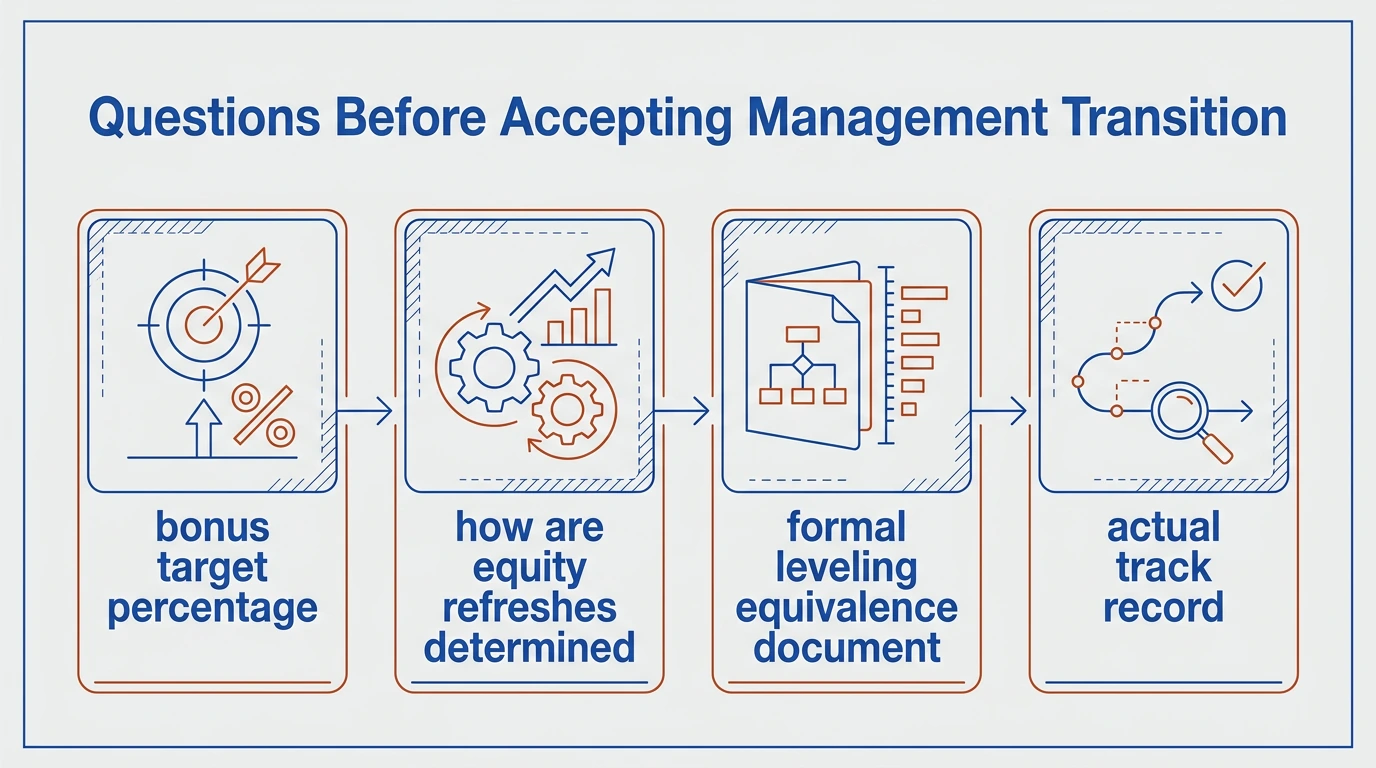
Rather than assuming compensation structure carries over unchanged, engineers considering a move into management benefit from asking direct questions of their manager or HR business partner: what is the bonus target percentage at the new management level compared to your current IC level; how are equity refreshes determined for managers at this level, and by whom; is there a formal leveling equivalence document you can review; and what is the company's actual track record — not just stated policy — for engineers who move back to IC roles after a period in management.
The first-line-manager compensation gap is a documented pattern worth checking for
At some companies, first-line engineering manager compensation bands overlap significantly with senior IC bands rather than representing a clear step up, particularly in the first year or two of the transition before a manager has had a full review cycle under the new track. This is not universal, but it is common enough that engineers considering the move should explicitly ask how current total compensation compares to what a strong performance cycle would have yielded had they stayed on the IC track at the same tenure — a comparison worth making honestly rather than assuming management is automatically a compensation upgrade.
Non-compensation factors that still belong in the financial decision
Time allocation changes substantially with a management transition — less individual coding or design output, more meetings, one-on-ones, and organizational overhead — which is not itself a compensation question but does affect the sustainability and job satisfaction side of the decision that ultimately feeds back into long-term earning potential and career trajectory. A purely compensation-focused analysis that ignores whether the role itself is a good long-term fit is incomplete in the other direction.
A trial period or "acting" role can de-risk the financial decision
Some companies offer a formal or informal trial period — an "acting manager" designation, a temporary team lead assignment, or a defined evaluation window — before a permanent track switch and its associated compensation structure changes take full effect. Where available, this arrangement lets an engineer test the role's actual day-to-day fit before the leveling and refresh-criteria changes become locked in, and is worth asking about directly rather than assuming the only path into management is an immediate, permanent track change with no evaluation period.
Even without a formal trial designation, it is reasonable to ask a prospective manager directly what specific expectations and success criteria apply to the first two or three months in the role, and how those criteria will inform the eventual decision to make the transition permanent — treating the early period as an implicit evaluation window even where the company has no official process labeled as one.
The takeaway
An engineer-to-manager transition often changes bonus structure, equity refresh criteria, and sometimes effective leveling — changes that are not always obvious from the title change alone. Ask specific, direct questions about compensation structure differences before accepting the transition, check whether your company's first-line-manager bands meaningfully exceed senior IC bands at your tenure, and model the decision honestly against what a continued strong IC track record would likely have yielded.
Want someone to look at your own numbers? , a free matching service, not an adviser.
Margin note
Want someone to check your numbers?
Up to three advisors who take requests from engineers and technical careers can see what you need. , a free matching service, not an adviser.
Important context
Is this personalized financial or tax advice?
No. These articles are general education for engineers and technical professionals, not personalized financial, tax, or legal advice. Equity plans, 401(k) plan documents, and tax rules vary by employer and change over time — verify specifics against your own plan documents and a licensed professional before acting.
Who publishes this content?
Heath for Engineers is an independent educational publication for software engineers and technical professionals. It gives no personalized advice. It can refer readers to a licensed financial advisor, and it is funded by advertising and by advisors who pay for introductions.
How do I go deeper on a topic covered here?
Use our calculators to model your own RSU, AMT, and allocation scenarios, or reach out via the contact form below to describe your situation. If you want a person to look at your own numbers, submit the inputs: we check them with you, then refer you to a licensed advisor who works with engineers.
Related sheets
- RSU Vesting and the Tax-Withholding Shortfall Nobody Warns You About
Your company withholds shares at a flat supplemental rate on every RSU vest. For most engineers in mid-to-high tax brackets, that rate is not enough — and the gap shows up as a surprise bill.
- ISO vs. NSO: Stock Option Basics Every Engineer Should Model
Two option types, two different tax triggers, two different risk profiles at exercise. The type printed on your grant agreement changes the entire decision tree.
- AMT Planning for Startup Equity: A Systems View
The alternative minimum tax behaves like a second tax system running in parallel to your normal return. For engineers exercising ISOs at a startup, understanding both systems is not optional.
Get matched with independent advisors through Heath Advisor Match
Free for you. No obligation. At most three advisors.
You answer a few questions
Four short steps: your situation, your finances in ranges, your goals and how to reach you. It costs you nothing.
A person reads your request
Someone on our team reads every request before any advisor sees it, and may call or email you if a detail needs checking.
Up to three advisors can take it
Advisors who signed up to receive requests from this site see your needs, your money ranges and the first three digits of your ZIP code, never your name, email or phone. At most three of them can pay to take your request.
You decide
The advisors who take it receive your contact details and may get in touch the way you prefer. Whether you talk to them, and whether you hire anyone, is your choice.